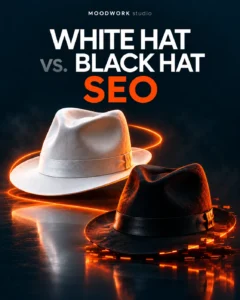

WHITE HAT VS. BLACK HAT SEO
What Your Business Should Know
When customers search for the services you offer, your website has an opportunity to become their first impression of your brand. How you earn that visibility matters.
SEO proposals can look similar on the surface: more keywords, better rankings, increased traffic. The methods behind those promises can be very different.
Understanding white hat vs. black hat SEO helps you evaluate those methods, ask better questions, and choose an approach that supports your business over time.
This guide explains the difference, outlines common warning signs, and shows how MOODWORK studio approaches search optimization.

IN THIS GUIDE
What Is White Hat SEO?
White hat SEO is the industry term for optimization practices that follow search engine guidelines while helping people find and use relevant information.
It includes creating useful content, making pages accessible to search engines, and organizing a website clearly. Google’s Search Essentials recommends these fundamentals as part of improving a website’s search presence.
For a business, that means building pages that answer customer questions accurately and explain your services clearly. Each improvement should have a purpose you can understand and a benefit you can explain.
What Is Black Hat SEO?
Black hat SEO refers to tactics that manipulate search rankings in ways that violate search engine spam policies.
Examples include keyword stuffing, deceptive content, and manipulative link schemes. Google may respond to violations through automated systems or manual actions, potentially reducing visibility or removing affected content from search results.
White Hat vs. Black Hat SEO at a Glance
| Area | White Hat SEO | Black Hat SEO |
|---|---|---|
| Content | Useful, original information | Content created primarily to manipulate rankings |
| Keywords | Relevant terms used naturally | Excessive, unnatural repetition |
| Links | Earned references and properly qualified paid placements | Links arranged to manipulate rankings |
| Presentation | Accurate information for visitors and search engines | Deceptive differences between what each sees |
These distinctions reflect Google’s guidance on helpful content, spam, and paid links.
What White Hat SEO Looks Like in Practice
1. Understanding What Your Audience Needs
A useful SEO strategy begins with the questions your customers are trying to answer.
Someone searching for “what is technical SEO” needs an explanation. Someone searching for “SEO services for a small business” may be evaluating providers. These searches call for different pages, different information, and different next steps.
For a service business, a practical content plan might include:
- Educational articles that answer early questions.
- Service pages that explain scope, process, and suitability.
- Case studies that demonstrate real work and documented outcomes.
- Clear contact options for visitors ready to discuss a project.
This gives each page a defined role in the customer’s decision.
2. Creating Content That Adds Value
Useful content should help readers understand something, solve a problem, or make a decision.
Google encourages original information, clear sourcing, and content created primarily to benefit people. It also states that there is no preferred word count for ranking.
For a studio, meaningful detail might include explaining a project constraint, showing how a design decision was made, or describing what a client should prepare before a website build.
That specificity gives readers a reason to choose your article over a generic explanation. The right length is the length needed to answer the question clearly.
3. Making Pages Easy to Understand
On-page optimization helps communicate what a page covers.
A descriptive title, a clear main heading, and useful subheadings give readers a structure they can follow. Keywords belong where they accurately describe the subject.
Google recommends concise, descriptive titles and may use several page elements when generating the title shown in search results.
A meta description should provide an accurate preview of the page. Google may use it for a search snippet, although it can also select text from the page depending on the query.
4. Supporting Content With Technical Foundations
A well-written page still needs to be accessible.
Technical SEO includes checking whether important pages can be crawled, whether their content is available to search engines, and whether the site is organized logically. Google’s SEO Starter Guide explains how these foundations help search engines discover and understand content.
For a business website, technical reviews should produce clear priorities: what needs attention, which pages are affected, and why the change matters.
5. Connecting Relevant Pages
Internal links help visitors continue their research and help Google discover pages and understand their relationships. Descriptive link text makes the destination clearer.
For example, an article about SEO can naturally lead readers to a relevant service page. A website planning guide can point to a development service or a useful project example.
Each link should offer a sensible next step.
Common Black Hat SEO Tactics to Recognize
Business owners should be able to recognize these warning signs:
- Keyword stuffing: repeating search terms unnaturally.
- Cloaking: deceptively showing different content to search engines and visitors.
- Hidden text abuse: concealing keywords or links to manipulate rankings.
- Link spam: arranging links primarily to manipulate ranking signals.
- Doorway abuse: creating similar pages that funnel visitors to another destination.
These practices are covered by Google’s spam policies.
Paid advertising and sponsorships have legitimate uses. Google advises qualifying paid links with rel="sponsored"; rel="nofollow" is also acceptable. The distinction matters when evaluating a proposal that includes paid placements.
A Practical Example: Improving a Service Page
Imagine a business whose website development page receives visits but generates few relevant inquiries.
A useful review would ask:
- Does the page explain which businesses the service suits?
- Are the deliverables and process clear?
- Does it answer common questions about scope and timelines?
- Are there relevant examples of completed work?
- Can visitors easily request a consultation?
The resulting work might include rewriting unclear sections, adding genuine project evidence, improving navigation, and simplifying the inquiry process.
That creates a page the business can use confidently in search, sales conversations, and direct referrals.
How to Evaluate an SEO Agency
Before choosing an agency, ask how its recommendations connect to your business.
Useful questions include:
- Which pages and customer needs will you prioritize?
- What changes will you make, and why?
- How will you create and review content?
- How will you approach external links and paid placements?
- What will your reports measure?
Google recommends discussing an SEO provider’s methods, communication, expected results, and measurement approach. It also warns that nobody can guarantee a number-one ranking.
Set business measures alongside search measures. For a service company, relevant inquiries, booked consultations, and suitable project opportunities help reveal whether increased visibility is commercially useful.
MOODWORK studio
How MOODWORK studio Approaches White Hat SEO
At MOODWORK studio, we use white hat SEO to help businesses build a stronger organic presence through useful content, clear website structure, and thoughtful optimization.
We connect search strategy with the wider brand experience: how people discover your business, how your website communicates its value, and how visitors take the next step.
Our approach focuses on:
- Search strategy: identifying relevant customer questions and opportunities connected to your services.
- Content and on-page optimization: developing clear information, descriptive titles, and purposeful page structures.
- Website foundations: bringing SEO considerations into website design and development.
- Brand consistency: keeping your message recognizable across educational content and service pages.
Every recommendation should serve a clear purpose. We want your website to explain your expertise convincingly and give potential clients the information they need to move forward.
Ready to strengthen your organic presence? Talk to MOODWORK studio about an SEO approach built around your business.
Frequently Asked Questions
How long does white hat SEO take to work?
There is no universal timeline. Google explains that some changes can appear within hours, while others may take several months. Assess progress over a suitable period, and remember that individual changes may have no noticeable effect.
Is AI-generated content considered black hat SEO?
Using AI does not automatically make content a spam violation. Google’s guidance focuses on quality, accuracy, relevance, and value for readers. Generating many pages without adding value may violate its scaled content abuse policy. AI-assisted material should receive careful factual and editorial review before publication.
Does duplicate content automatically cause a penalty?
No. Google states that duplicate content on a website is not, by itself, a spam policy violation. It can still create confusion and unnecessary crawling, so duplicate URLs may need appropriate canonicalization.
Can paying for Google Ads improve organic rankings?
No. Google states that advertising does not affect a website’s presence in organic search results. Advertising and organic SEO should have their own objectives and measurement.